As-built documentation? Fully digital, thanks to BIM
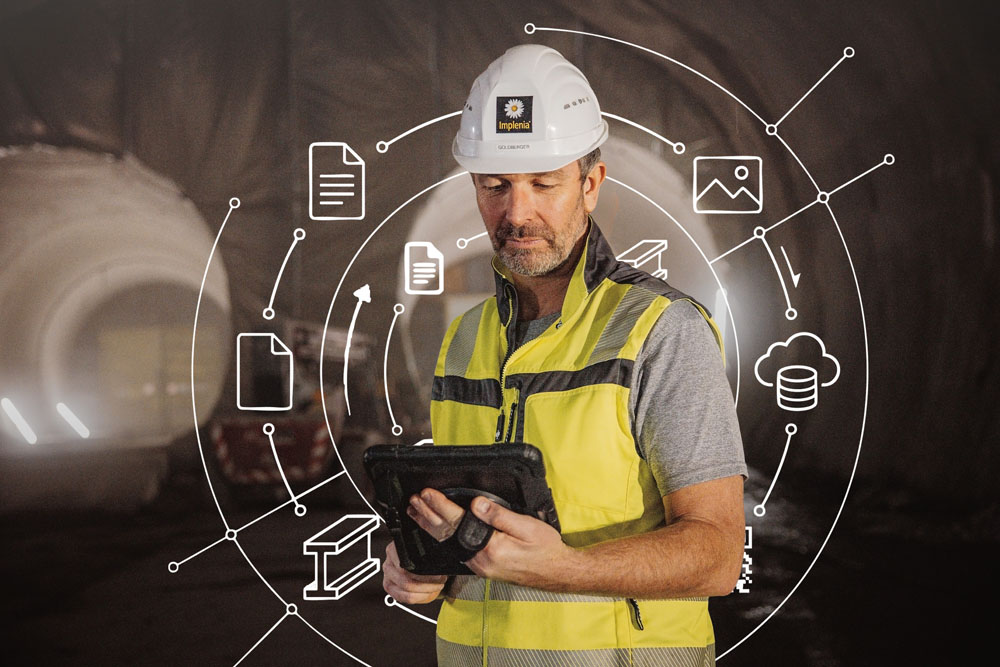
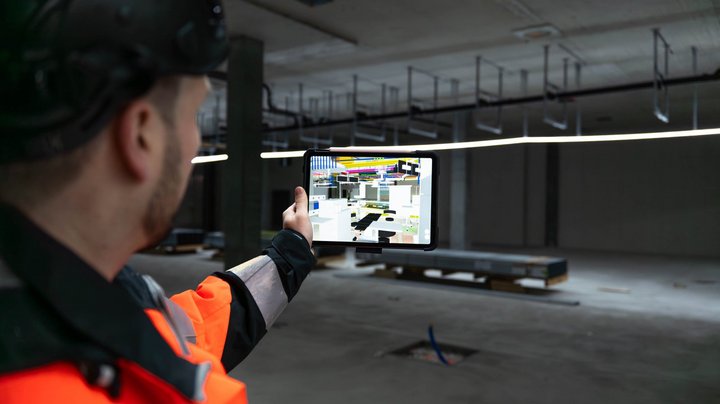
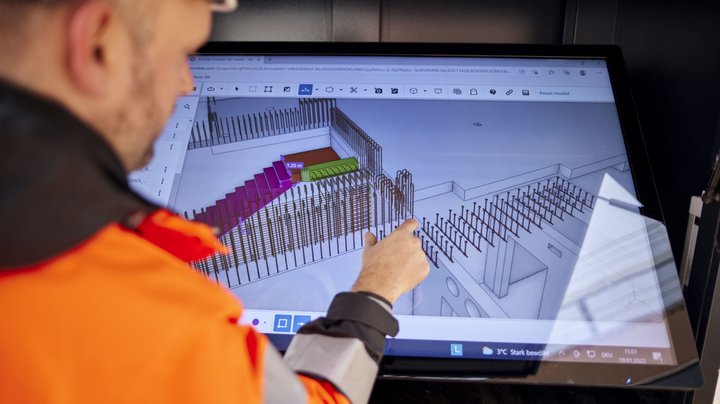
You click on a tunnel wall in the BIM model and instantly get every quality report, photo, and certificate referenced to it. Structured, complete, and ready to use. Not just for project closeout, but for decades of operation ahead.
"Digital as-built documentation is one of the most requested capabilities from our clients," says Felix Stauch, Head of BIM in Implenia's Civil Engineering division. "That's not a temporary trend. Our role is to make sure Implenia is ready to consistently deliver on that expectation. The question is no longer whether to do it, but how to make it repeatable across projects and countries." Two projects in Scandinavia show what that looks like in practice.

Getting documentation future-ready
On most construction projects, handover still looks the same as it did twenty years ago: thousands of files in nested folder structures. Inspection reports in one place, photos in another, certificates in a third. Documentation exists, but it's disconnected from the physical asset. Hard to find, impossible to analyse, and largely useless for operations.
For clients who need to maintain, inspect, and operate infrastructure over decades, this is more than an inconvenience. It's a risk. And as requirements for digital asset management grow, the gap between what clients need and what they actually receive at handover is widening.
Lessening the administrative burden
But the problem doesn't only affect clients. For contractors, managing documentation across disciplines, subcontractors, and approval workflows during construction is a significant administrative burden. Tracking which documents are complete, which are pending, and which are linked to the right building element consumes time and creates friction.

At E39 Lyngdal in Norway and Station Barkarby in Sweden, Implenia took a fundamentally different approach. Instead of treating documentation as a post-construction exercise, the teams built it up systematically on the BIM model throughout the entire construction phase. Every document, from checklists and certificates to inspection reports and photos, was linked directly to the relevant building element as the work progressed.
The result: at handover, the BIM model didn't just represent the geometry of the asset. It functioned as a navigable, structured archive of everything that had been built, tested, inspected, and approved.
Prerequisite: Common Data Environment (CDE)
None of this would have been possible without a Common Data Environment (CDE) as the central platform for capturing and managing project documentation digitally. The CDE provided the shared infrastructure where all disciplines could contribute, review, and approve documents in a single, structured system. But technology alone wasn't enough. Making this work required cross-functional collaboration well beyond the BIM team. Quality managers defined what needed to be documented and to which standard. Site supervisors captured data in the field. Document controllers ensured completeness and correctness. The BIM team provided the link between the documentation and the model. It was only through this coordinated effort across functions that the documentation became more than a collection of files.
One successful project is a good story. Two projects in different countries with a transferable approach is a capability. That's why this isn't just about Norway and Sweden. It's about how Implenia builds and scales digital methods across its organisation. The local BIM teams led the implementation on their projects. At the division level, Implenia's Project Excellence & Services (PES) BIM function provides strategic guidance based on the inputs and learnings from all projects, turning individual project experience into a repeatable approach.
E39 Lyngdal, Norway: 25,000 Documents, one model
The E39 Lyngdal Øst – Lyngdal Vest project is a 9.5-kilometre road corridor in southern Norway, comprising two tunnels, seven bridges, and complex supporting infrastructure. Delivered as a turnkey contract for Nye Veier by a joint venture of Implenia Norge and Stangeland Maskin, the project was completed within budget and several months ahead of schedule, following 1.6 million work hours.
At the heart of the project's documentation approach was a Systematic Completion (SC) process. Each discipline documented its work continuously according to defined requirements. Document controllers verified that every document contained correct and relevant information before publishing it into Implenia's document library. Critically, each document was assigned a structured object code. This object code served as the linking key that connected it to the corresponding element in the BIM model.
Anders Loven, BIM Responsible for Implenia's tunnelling operations in Norway, set up this process and onboarded the site teams. On the ground, Glenn Isaksen and Runar Bach ensured that everything came together on a daily basis, updating the BIM models with object codes and keeping the documentation connected and current as construction progressed.
«This was in many respects an innovative project, and I want to highlight digitalisation as a key factor in ensuring quality and efficiency.»
– Anita Enebakk, Project Manager, Nye Veier
The scope was significant: approximately 30,000 unique documents were linked to the model, spanning data sheets, declarations, certificates, guidelines, procedures, reports, manuals, checklists, and photos.
The biggest challenge? Establishing the object coding system that formed the foundation for the entire process. Once that structure was in place, it enabled the BIM model to function as an effective navigation interface to the underlying documentation.
The Lyngdal Project
Station Barkarby, Sweden: From paper to platform
At Station Barkarby near Stockholm, the challenge was different but the goal was the same: deliver structured, model-linked documentation that the client could actually use. David Santos, BIM Responsible for Implenia's tunnelling operations in Sweden, set up the documentation process and onboarded the site teams onto the platform.
The project team worked with 82 BIM models for concrete works alone. Three standardised checklists were created for each concrete element: two completed by Implenia's site supervisors before casting, and one completed by the subcontractor's supervisors after casting. In total, 1,312 checklists were linked directly to the models, with approximately 3,000 photos connected to the checklists. Beyond concrete, the team completed groundwork inspection reports, receiving inspections for water and sewage systems and checklists for cable brackets and trays through the common data environment.
The biggest challenge was cultural, not technical. Production teams were still accustomed to working with paper from previous projects and to scanning documents manually into PDFs. This is where Azahdeh Parsaei played a critical role. As the key user on site, she took care of the daily operations, supported colleagues in using the process, and served as the local multiplier who ensured that adoption actually happened. The transition required more time than initially expected, but having a dedicated person bridging the gap between the digital workflow and the reality on site made the difference.
But the investment paid off. Because the documentation was structured and linked to the model throughout construction, the team could track completion status at any time. At handover, the client received an organised, traceable set of documentation that was straightforward to review and follow up on.


Barkarby Station: The BIM implementation was led by David Santos, BIM Responsible Tunnelling Sweden, with Azahdeh Parsaei on the project
What made it work
Two things stand out across both projects:
First, documentation was not an afterthought. It was embedded into the construction workflow from day one. The teams didn't document after the fact. They documented as they built. This created value in both directions: site teams could navigate documentation visually through the BIM model, finding what they needed by clicking on the element in front of them. Back office teams benefited from significantly less administrative work, because the structure was already in place rather than having to be created after the fact.
Second, the approach is transferable. These weren't isolated successes. By feeding project learnings back into the organisation, Implenia is building a scalable method. One that the next project can adopt and adapt, rather than reinventing from scratch.
The result is a new standard for what a digital handover can look like. And a proof point for clients who want more than a USB stick full of PDFs.