Water and frost protection for tunneling
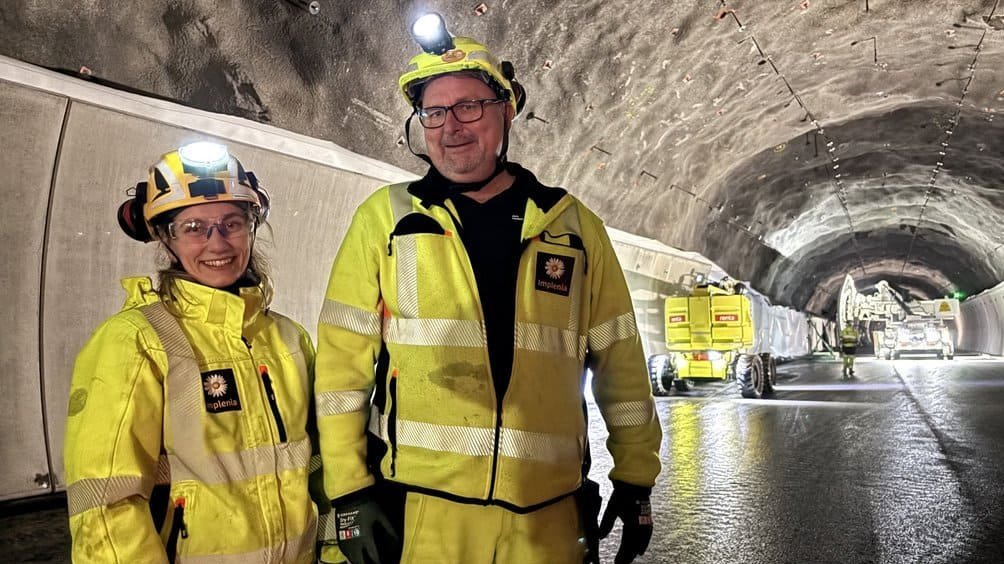
On a tunnel project, it is often the tunnelling itself that attracts the most attention. But the path to a completed tunnel system involves far more than blasting alone. Once the rock has been excavated, painstaking work begins, with several disciplines working closely together to finish the tunnel.
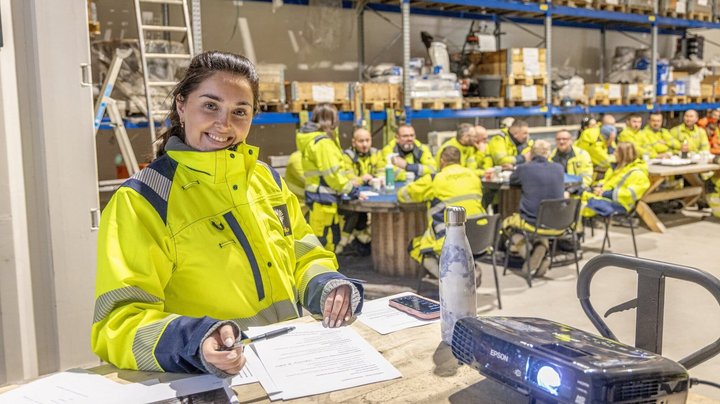
“When the drilling and blasting is done, the real work begins. Every detail matters here, and we work to the millimetre,” explains Ann-Mari Beitdokken, site manager at Implenia Norway.
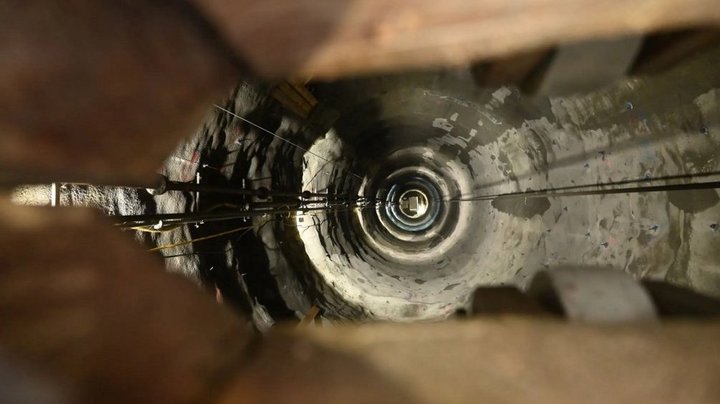
Ann-Mari works on the Rogfast project in Randaberg, where Implenia is building the Boknafjord Tunnel for the Norwegian Public Roads Administration. When completed, the tunnel will be the deepest and longest subsea road tunnel in the world.
The project E39 Rogfast, Lot E02 Kvitsøy

Lot E02 Kvitsøy is considered the most complex part of the Rogfast project and comprises an approximately 8.8 km long, twin-tube, dual-lane road tunnel with a cross-section of 10.5 metres, running both south and north of Kvitsøy. In addition, a complex underground intersection with roundabouts and a connection to Kvitsoy via an underground ramp.
At Rogfast, water and frost protection is carried out using concrete elements. For the installation to proceed as planned, the groundwork must be extremely accurate.
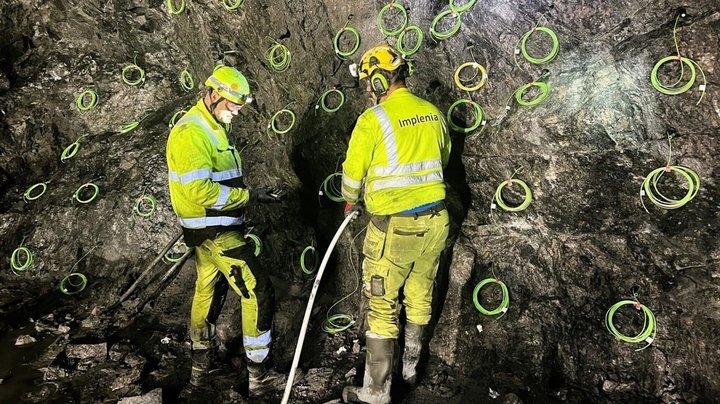
Before the concrete elements can be lifted into place, the tunnel must be thoroughly prepared. First, the rock is secured and the surface is prepared. Then bolts and fastening details are drilled and installed to provide the correct fixing points for the elements. Next, a membrane is installed behind the structure as waterproofing. Once this is done, work on the anchoring begins. High precision is crucial to ensure the installation proceeds efficiently and according to plan.
Millimetre-precise installation
The team uses setting-out and surveying to ensure that the bolts are positioned with high precision, so that the concrete elements can be lifted efficiently into place during installation.
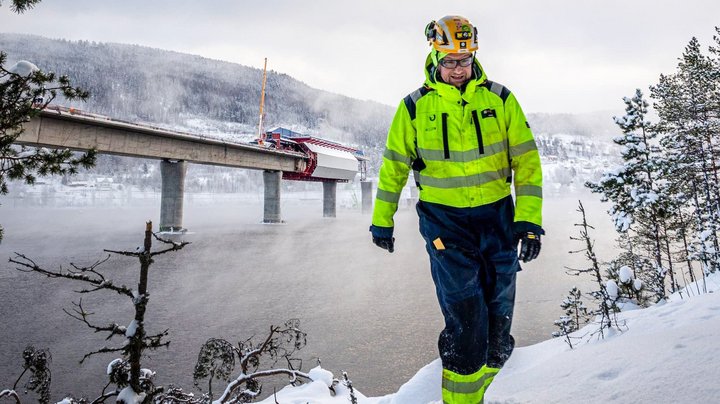
“Many different methods are used for water and frost protection, but on the Rogfast project we do this with concrete elements,” explains supervisor Øystein Opseth.
The work is carried out using an Essverk element machine with vacuum. The equipment is remote-controlled by the operator via the control panel. This provides good control of the work and contributes to safe and efficient execution, with all HSE considerations taken into account.
Working in parallel with the tunnel driving
On the Rogfast project, the situation is a little different than on many other tunnel projects. Here, the water and frost protection work runs in parallel while the tunnel is still being excavated at the face. This calls for good coordination and day-to-day adjustments between the teams, but it works well in practice.
“As long as the ventilation works as well as it does, it’s no problem working in a tunnel where drilling and blasting is taking place at the same time. The fact that several activities are going on simultaneously shows both the capacity and the interaction within the project,” Ann-Mari emphasises.