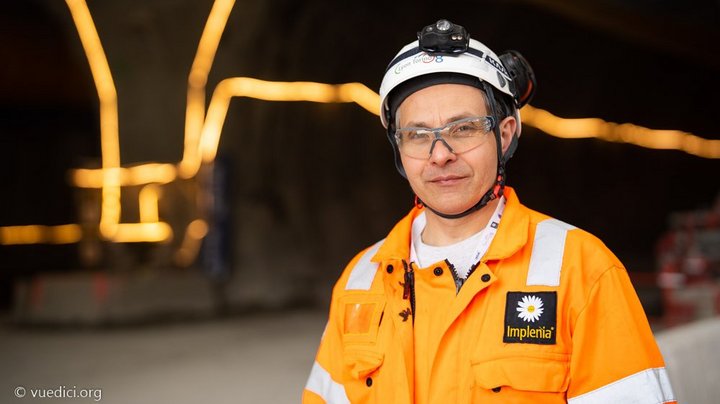
Custom-made tools in pictures

The result of a year of design work, including consultations with numerous tool manufacturers across Europe, these systems were then assembled on site over several months. They are now deployed over more than 500 metres, from the preparation of the invert through to the pouring of the vault.
Discover in images the assembly of all the tools specially developed to carry out the tunnel’s final vault that is, the upper part of the structure.
“It is the result of a genuine team effort, where every piece of feedback from the field helped optimise the design and operating methods,” emphasises Florent Baulat, co-designer of the tools.
The works are currently being carried out on the even track (right-hand tube), while the odd track (left-hand tube) remains dedicated to logistics for the excavation of the tunnel faces, which is still ongoing upstream. At a later stage, all the tools will be duplicated on the odd track in order to continue the lining works.
A mechanised industrial production line
A large part of these workstations is mechanised. Lifting operations are mechanised using winches, and the equipment is carried and stored on mobile gantries, making it easier to move them as the works progress. This organisation makes it possible to clearly locate the different activities, manage the risks associated with simultaneous operations, and optimise team safety.
The entire system operates like a true industrial production line, adapted to the specific logistical constraints of a large-scale underground construction site.
Rigorous quality controls
“Each phase is subject to rigorous quality controls, which are essential to ensure the structure’s long-term durability,” explains Florent Baulat, Lead Lining Engineer. At every stage, strict validations are carried out, covering dimensional and quantitative aspects as well as operating procedures and installation methods. In total, nearly 175,000 m³ of concrete will be required for the final lining to complete our section, representing 5,680 metres.
Let us now look at the main tools, following the route from the tunnel entrance.
The vault formwork gantry
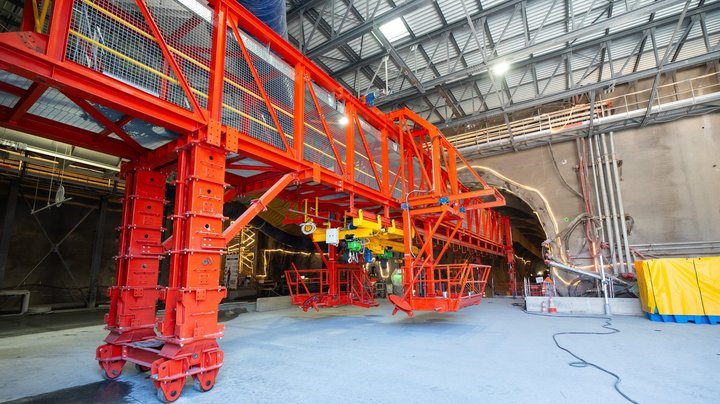
Designed and manufactured in France, this vault formwork gantry— weighing close to 100 tonnes allows for the concreting of vaults with thicknesses ranging from 50 to 140 cm. In just a few hours, up to 200 m³ of concrete can be placed, corresponding to around ten linear metres of fully lined tunnel.


The reinforcement gantry
Using the reinforcement gantry, our crews install around 10 tonnes of reinforcement steel over a three-day period, enabling progress of 10 linear metres of tunnel. This demanding operation relies on meticulous work: the reinforcement bars are positioned and tied entirely by hand.


The waterproofing gantry
This gantry is mechanised and is primarily used to install the PVC waterproofing membrane. This membrane ensures the tunnel’s watertightness and contributes to the structure’s long-term durability.
The waterproofing system consists of three layers: a first geotextile layer protecting the PVC membrane, followed by an additional PVC protection layer on the extrados to safeguard the membrane in reinforced areas. It is a meticulous process, combining both automatic and manual welding, while strictly adhering to the fusion temperatures specified in the installation procedures.


A lifting tool
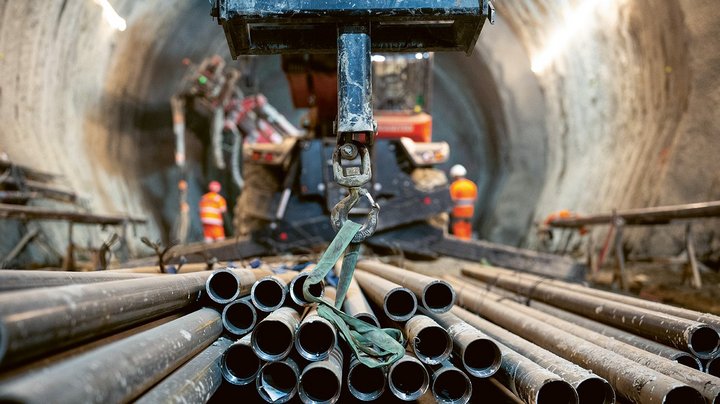
The “yellow” lifting gantry is a specialized tool designed to handle large components, such as pipes weighing nearly 400 kg or concrete chambers and inspection shafts weighing up to one tonne. These elements will be used to collect water and hazardous materials during tunnel operation. Once installed and secured, a filling concrete is poured.


The invert workshop
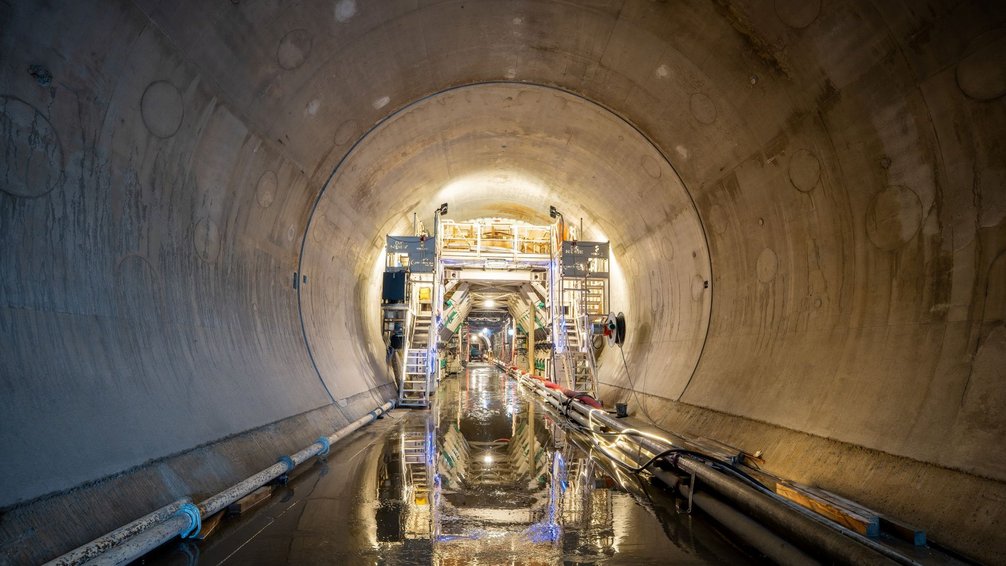
The first workshop in the process is the invert workshop, dedicated to constructing the tunnel slab. It enables the installation of waterproofing, reinforcement, and concrete pouring. It incorporates several pieces of equipment, including lifting winches for material handling, as well as two removable telescopic walkways that allow for the installation of waterproofing at the springing of the vault. The workshop also supports the formwork for the invert. During the pouring of 80 m³ for an invert section, the tool counteracts the Archimedes thrust and rests on the upper part of the tunnel (photo: braces), bearing several tonnes.


Technical expertise in the service of an exceptional structure
The construction of the lining at the Mont-Cenis Base Tunnel entrance illustrates the complexity and precision required for a project of this scale. At every stage, the teams must contend with specific constraints, such as the prior relocation of water, lighting, communication, and electrical networks, which is essential to clear the areas needed for construction progress. Additionally, before the invert workshop passes through, the excavated tube must be excavated further, fully cleaned, and finished at the lower section. The temporary shotcrete lining must be leveled and any defects filled to meet the geometric tolerances required by the waterproofing system.
Innovation, safety, and industrial performance come together daily to ensure the quality and long-term durability of a major infrastructure within the European network.

Explore the tunnel and its custom-made tools in images with Florent Baulat, Lead Lining Engineer, & Jean Philippe Royere, Site Manager.
For more details on the invert workshop, see …

The TELT Project

The Turin–Lyon railway project is a high-speed line currently under construction. At the heart of this project is the 57.5 km Mont Cenis Base Tunnel, which forms a new railway axis between Lyon and Turin. The entire new line covers around 270.8 km, of which 140 km is in France and 46.7 km in Italy. The project is an important part of European rail infrastructure planning and is supported by the EU. It is intended to speed up east-west rail transit traffic between France and Italy and is part of the TEN rail axis No. 6 between Lyon and Budapest.
Implenia is part of the TELT project, which includes the construction of the Mont Cenis Base Tunnel. In 2021, Implenia was commissioned to build Lot 3 of the tunnel, together with its consortium partners NGE, Rizzani De Eccher and Itinera Spa1. The project involves the construction of two 2,839 m long tubes towards Italy, including 11 safety cross passages and 140 m of open-cut tunnel.
Key figures
| 5,6 km | tunnel to be excavated |
| 1'018 m | in umbrella vaults |
| 1'078 | laying arches |
| 11 | safety engines |
| 600'000 m3 | earthworks |
| 2'700 m2 | acoustic hangar |
| über 127'000 m2 | site facilities |
| 5 years | construction period |
| EUR 228 Mio. | order volume |
| over 300 people | on site during peak times |